
Texas Buyer Representation Agreement: What Fort Bend Buyers Sign in 2026

Texas Buyer Representation Agreement: What Fort Bend Buyers Sign in 2026
You found four houses you want to see in Cross Creek Ranch on Saturday. You call an agent Thursday night. Before anyone puts a Saturday morning on the calendar, they email you a form — most likely a Texas buyer representation agreement — and ask you to sign it.
A few years ago that would have been unusual. As of January 1, 2026, it is Texas law.
If you have not bought a home since 2023, the paperwork at the front of the process looks different than you remember, and the forms arrive earlier. None of it is complicated once you know what each document does. But signing something you have not read, on a Thursday night, because an agent said it is required, is not a great way to start a six-figure transaction. Here is a walk through of what you will actually be handed and what each piece commits you to.
What changed on January 1, 2026
The Texas Legislature passed Senate Bill 1968 in 2025, and it took effect at the start of this year. It is the most significant rewrite of Texas real estate agency law in a long time.
Three changes matter most to you as a buyer:
A written agreement is now required before an agent performs acts of brokerage for you. This is state law, not just a trade-association policy. The 2024 National Association of Realtors settlement already required written buyer agreements of its members before touring homes; SB 1968 put a version of that requirement into Texas statute and applies it to all Texas license holders.
Subagency was eliminated. Under the old framework, an agent who had not established a relationship with you could end up working for the seller by default, while walking you through a house. That default is gone. Now the relationship has to be stated in writing, one way or the other.
A “show only” option exists for people not ready to commit. More on that below, because it is the piece most buyers do not know about and it is the one that protects your optionality.
In practice, that means a Texas buyer representation agreement is now the default starting point for anyone who wants an agent working on their behalf.
The Texas Real Estate Commission has published its own summary of what changes in 2026 for buyer and tenant representation, and Texas REALTORS® has a plain-language explainer on the agency law changes. Both are worth ten minutes if you want the source material.
The three documents you are likely to see
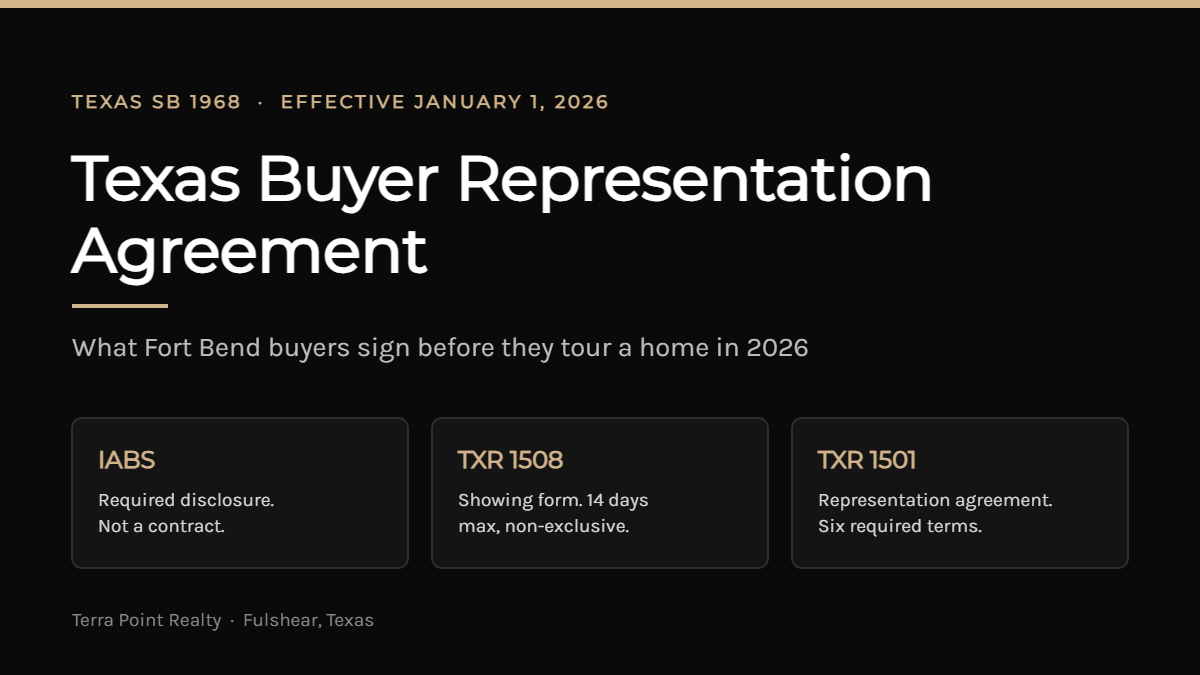
1. Information About Brokerage Services (IABS)
This one is not new and it is not a contract. It is a required disclosure that explains the types of relationships a Texas broker can have with you — agent for the buyer, agent for the seller, or intermediary. You are not agreeing to anything by receiving it. You are being told how the system works.
The IABS was revised effective January 1, 2026 to explain the SB 1968 changes, including when a written buyer agreement is required and how an agent can show you property without representing you. TREC hosts the current form and an explanation of the requirement.
If an agent has not given you an IABS, ask for it.
2. The Unrepresented Customer Showing Form (TXR 1508)
This is the new one, and it is the one buyers should know exists.
It lets an agent show you a property when showing is the only thing they are doing for you. They unlock the door. They do not advise you on price, they do not point out problems, they do not write your offer, and they do not owe you the duties of an agent. You are a customer, not a client.
Two limits are built in on purpose: it cannot be exclusive, and it cannot run longer than 14 days. It is not a Texas buyer representation agreement, and it is not meant to turn into one.
That combination is genuinely useful. If you are three months from being ready, or you are interviewing agents, or you just want to see one house on a Sunday before you commit to anything, this form lets you do that without tying yourself to anyone. Nobody is obligated to offer it. But you can ask.
The tradeoff is real, and I would not soften it: an agent operating under a showing form is not representing you. If you want someone in your corner on condition, price, or negotiation, that is not the form for that.
3. The Texas Buyer Representation Agreement (TXR 1501)
This is the actual representation contract. Signing it makes you a client, and it obligates the broker to represent your interests.
Under SB 1968, a written representation agreement has to spell out specific things:
- The services the license holder will provide
- When the agreement ends — a definite termination date
- Whether it is exclusive or non-exclusive
- Whether the license holder represents you as your agent
- The amount or rate of compensation
- Conspicuous language stating that broker compensation is negotiable and not set by law
That last item is not decorative. Compensation is negotiable, it has always been negotiable, and the statute now requires the document to say so where you cannot miss it.
TXR 1501 was also revised for 2026 — the word “Residential” came out of the title so it covers more transaction types, and an optional retainer provision was added, which allows a broker to collect an advance payment. If a retainer is filled in on the copy you receive, that is a term to discuss, not boilerplate to skim.
A summary of the January 2026 forms revisions is published by Texas REALTORS®.
How compensation works under a Texas buyer representation agreement
This is where most of the confusion sits, so let me be direct about the mechanics.
Your representation agreement states what your broker will be paid. That is an agreement between you and the broker. Separately, a seller may offer to contribute toward your broker’s compensation, or you may negotiate a seller contribution as part of your offer. Those are two different things, and the first one does not depend on the second.
The practical consequence: if the agreement says your broker earns a certain amount and the seller side contributes less than that, you are responsible for the difference. TXR 1501 contains language to that effect. Read it. Ask what the number would be in a scenario where the seller contributes nothing, and get a real answer before you sign, not after you are under contract on a house you love.
Some things worth knowing as you plan:
Seller contributions toward buyer broker compensation are negotiable in the offer, the same way a closing-cost credit is. They are not advertised in the MLS the way cooperating compensation once was, so your agent has to ask. We walk through both sides of that negotiation in who pays buyer agent commission in Texas.
Lender rules matter. Whether a seller contribution counts against interested-party contribution limits depends on the loan program. If you are stretching on cash to close, raise this with your lender early — it interacts with the numbers on our closing costs overview.
Shorter terms are negotiable too. If you are not ready to commit to six months with one brokerage, a shorter initial term or a non-exclusive agreement is a legitimate thing to ask for. We compare the two in detail in exclusive vs non-exclusive buyer agreements.
The builder model home question
This one comes up constantly in Fulshear and Katy, because so much of what is selling here is new construction in Cross Creek Ranch, Cane Island, Fulshear Lakes, Jordan Ranch, and Elyson.
With subagency eliminated, the relationship at a model home is clearer than it used to be. The onsite sales consultant works for the builder. They are not your agent, and under the new framework they are not going to end up as your agent by accident. That is not a criticism of builder representatives, many of whom are excellent at what they do. It is a description of who they answer to.
The rule that has not changed: most builders ask that your agent accompany you on your first visit for that agent to be recognized in the transaction. If you tour a model alone on a Saturday and bring an agent in two weeks later, the builder may decline to recognize them. If you intend to have representation, bring them the first time, or call ahead. Having a Texas buyer representation agreement signed before that first visit is the cleanest way to make sure your agent is recognized.
If you are early in a new-construction search, our pages on new construction in Fulshear and the broader buyer resources are a reasonable place to start reading.
Five questions to ask before you sign a Texas buyer representation agreement
- What is the term, and what does it take to end this early? A definite end date is required. Ask what happens if the fit is not right in week three.
- Is this exclusive or non-exclusive, and which are you proposing?
- What exactly am I on the hook for if the seller contributes nothing toward your compensation? Ask for the dollar figure on a specific price point.
- Is there a retainer, and is it credited at closing?
- What is included in “services”? Showings and offer writing are the obvious ones. Ask about inspection coordination, negotiation of repairs, builder contract review, and what happens if the deal falls apart.
Any agent who is annoyed by these questions has answered the most important one.
A closing thought
The point of SB 1968 is that a Texas buyer representation agreement puts in writing who is working for you before anyone starts working. That is a good change. It front-loads a conversation that used to happen halfway through a transaction, or never.
It does mean a little more paper at the beginning. It is worth reading. And if a form arrives Thursday night for a Saturday showing and you would rather not sign a six-month exclusive agreement before you have met anyone, the 14-day showing form exists precisely for that.
If you are starting a search in Fulshear, Katy, Richmond, Sugar Land, or Brookshire and want to walk through what representation would look like before committing to anything, we are happy to have that conversation first. Call us at (713) 766-1697, or start with our complete guide to buying a house and the first-time homebuyer guide.
About the author
About the author — Stacy Burgin, Broker, e-PRO®, TAHS, SFR®, HCSMS, PSA, TRLS, is the Broker and Founder of Terra Point Realty, a Fulshear-based brokerage serving Fort Bend and Waller Counties. A Houston native and Fulshear resident for over a decade, Stacy has been licensed in Texas real estate since 2013 and has closed over 300 career real estate transactions — including 130+ home sales representing nearly $30 million in sales volume — across the greater Houston area, from $20,000 entry-level properties to $1.2M luxury homes. She is a HAR Platinum Agent (4.89/5 across 124+ post-transaction client surveys). TREC License
#630159. Terra Point Realty, LLC — TREC Broker License #9002493. Member, Houston Association of Realtors. As a Texas broker, Stacy reviews every representation agreement Terra Point presents and is glad to walk a buyer through the terms line by line before anything is signed.
Terra Point Realty, LLC — TREC Brokerage License #9002493. Information About Brokerage Services · Consumer Protection Notice · Equal Housing Opportunity.
This article is general information about Texas real estate practice, not legal advice. For advice about your specific situation, consult a Texas attorney.